





 Wolfram Sander, reefcolors.com


Info
Allen & Robertson, 1974
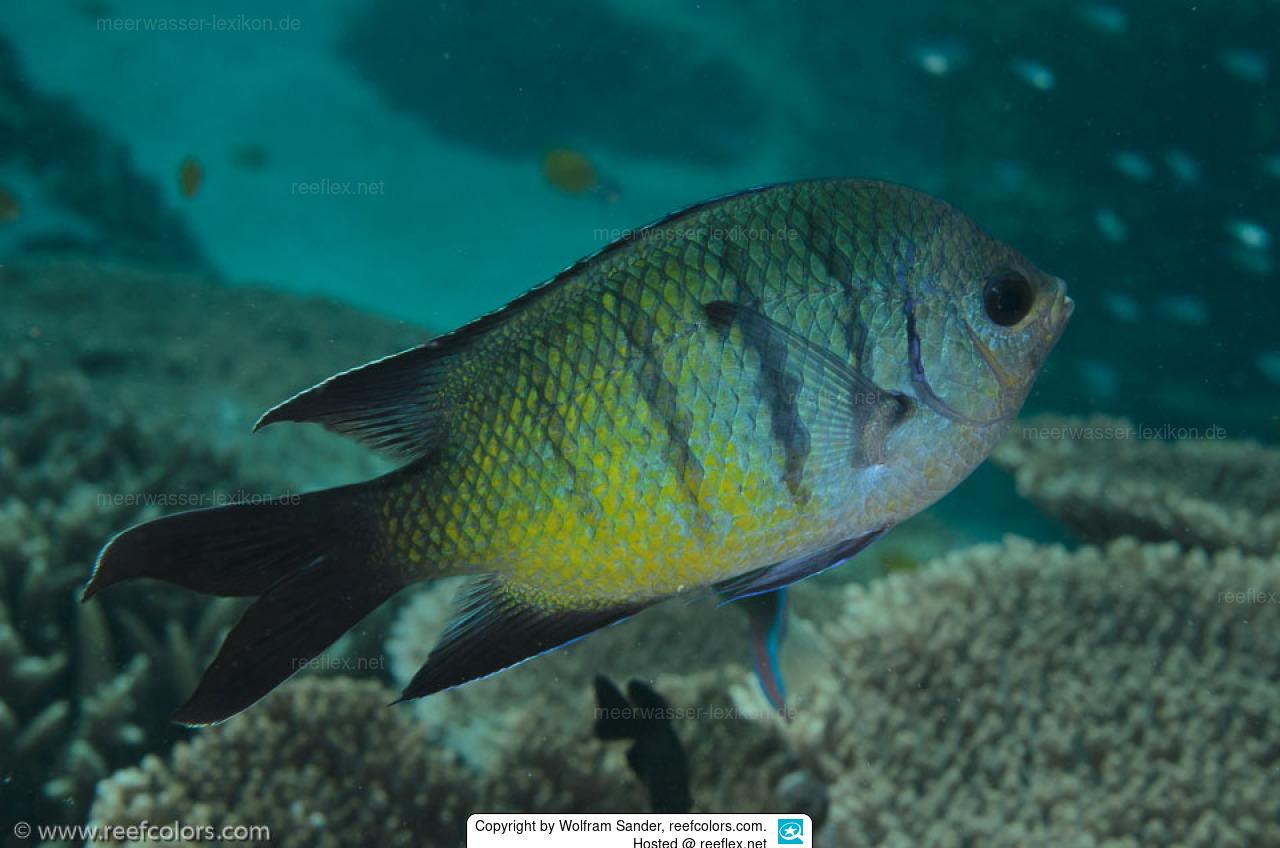
This reef bass can be easily distinguished from other Abudefduf reef basses by its 4 to 5 narrow, dark body stripes and its dark caudal fin.
Abudefduf whitleyi inhabits shallow coral reefs down to a depth of about 5 meters, making it easily accessible to divers.
Feeding schools of a hundred or more individuals can often be observed swimming high above the substrate.
According to FishBase, this grouper is displayed in various public aquariums.
Etymology:
The species is named whitleyi after Gilbert P. Whitley, former Curator of Fishes at the Australian Museum, in honour of his many contributions to Australian Ichthyology.
Classification: Biota > Animalia (Kingdom) > Chordata (Phylum) > Vertebrata (Subphylum) > Gnathostomata (Superclass) > Pisces (Superclass) > Actinopterygii (Class) > Perciformes (Order) > Pomacentridae (Family) > Pomacentrinae (Subfamily) > Abudefduf (Genus)

