


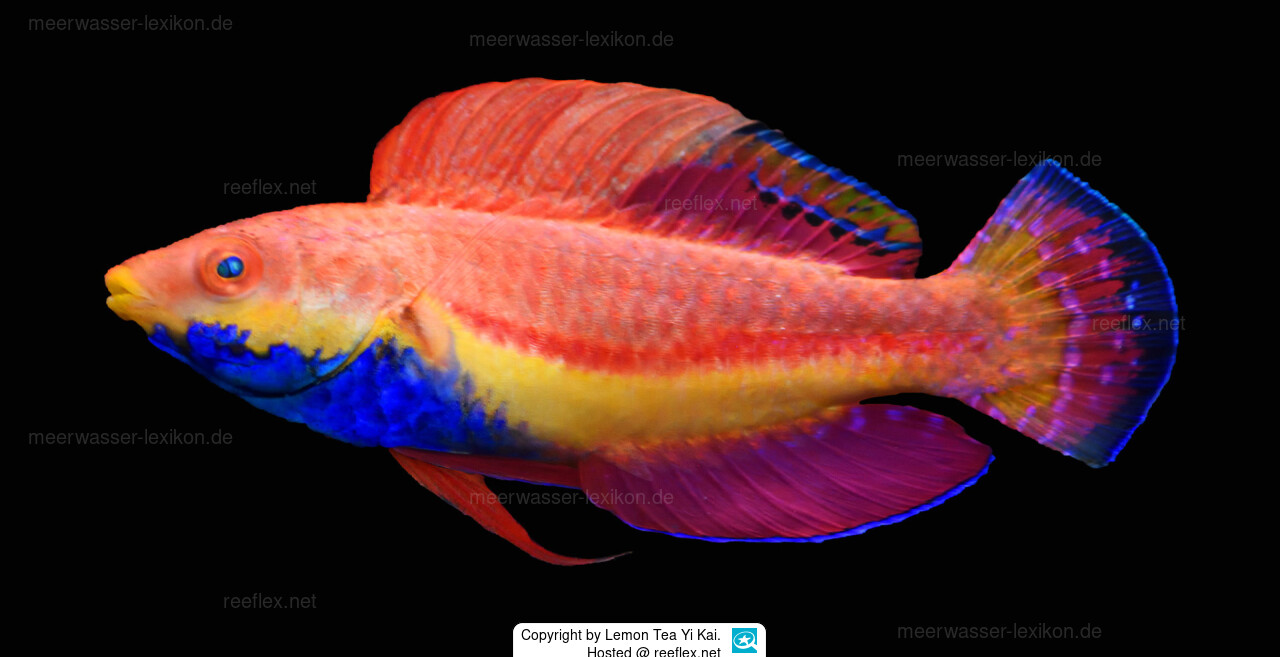
 Lemon Tea Yi Kai, Japan


Info
Tea, Frable, Gill, 2018
The first photo of this beautiful male dwarf wrasse was published by Lemon Tea YK in 2016 on his Flickr page
https://www.flickr.com/photos/lemonteayk/38314687894/in/photostream/.
At that time, however, the wrasse had not yet been scientifically described and was therefore initially listed as Cirrhilabrus sp.
The first description was then made in 2018, and this colorful dwarf wrasse was finally named “Cirrhilabrus cyanogularis.”
This new species was described on the basis of a holotype and three paratypes from Banguingui Island, Sulu Archipelago, in the extreme southwest of the Philippines, as well as a paratype from Sulawesi, Indonesia, and assigned to a complex consisting of the following species: Cirrhilabrus filamentosus (Klausewitz), Cirrhilabrus rubripinnis (Randall & Carpenter), and Cirrhilabrus tonozukai (Allen & Kuiter).
The most prominent feature, and the one responsible for the English name, is the intense blue area on the throat of this wrasse.
The initial description indicates that an animal of this species was sold to an aquarium in Sulawesi, Indonesia, by a fish collector as early as 2005.
Photographic documentation from the Kanagawa Prefectural Museum of Natural History showed that the new species had previously been photographed around Bali, Kalimantan (Borneo), Malaysia, and the Derawan Islands (Indonesia).
Like almost all species of the genus Cirrhilabrus, Cirrhilabrus cyanogularis was found at depths ranging from 4 to 30 meters above rubble slopes.
The females of this species look quite similar to the males, their bodies are uniformly orange to orange-red, with the color fading to a pale white on the belly.
Three to four fine white stripes can be seen on the back of the females, and there is a small black spot on the upper part of the caudal peduncle.
The dorsal and anal fins are translucent red and free of any markings, as are the pelvic fins and caudal fin, which, however, has a few indistinct spots.
The pectoral fins are also translucent.
The description of the females was based on color photographs and aquarium photos, but unfortunately we are unable to show any photos at this time. We will certainly do so at a later date.
Very special thanks for the wonderful photos of Cirrhilabrus cyanogularis to LemonTeaYK, School of Life and Environmental Sciences, University of Sydney, Sydney, Australia!
Source:
Zootaxa: https://doi.org/10.11646/zootaxa.4418.6.5
Autoren: YI-KAI TEA1, BENJAMIN W. FRABLE2 & ANTHONY C. GILL, 2018
Cirrhilabrus cyanogularis, a new species of fairy wrasse from the Philippines and Indonesia (Teleostei: Labridae)
Jumping guard
A jumping guard prevents (nocturnal) fish from jumping out.
Wrasses, blennies, hawkfishs and gobies jump out of an unprotected tank in fright if their night rest is disturbed, unfortunately these jumpers are found dried up in the morning on carpets, glass edges or later behind the tank.
https://www.korallenriff.de/en/article/1925_5_Jump_Protection_Solutions_for_Fish_in_the_Aquarium__5_Net_Covers.html
A small night light also helps, as it provides the fish with a means of orientation in the dark!
The first photo of this beautiful male dwarf wrasse was published by Lemon Tea YK in 2016 on his Flickr page
https://www.flickr.com/photos/lemonteayk/38314687894/in/photostream/.
At that time, however, the wrasse had not yet been scientifically described and was therefore initially listed as Cirrhilabrus sp.
The first description was then made in 2018, and this colorful dwarf wrasse was finally named “Cirrhilabrus cyanogularis.”
This new species was described on the basis of a holotype and three paratypes from Banguingui Island, Sulu Archipelago, in the extreme southwest of the Philippines, as well as a paratype from Sulawesi, Indonesia, and assigned to a complex consisting of the following species: Cirrhilabrus filamentosus (Klausewitz), Cirrhilabrus rubripinnis (Randall & Carpenter), and Cirrhilabrus tonozukai (Allen & Kuiter).
The most prominent feature, and the one responsible for the English name, is the intense blue area on the throat of this wrasse.
The initial description indicates that an animal of this species was sold to an aquarium in Sulawesi, Indonesia, by a fish collector as early as 2005.
Photographic documentation from the Kanagawa Prefectural Museum of Natural History showed that the new species had previously been photographed around Bali, Kalimantan (Borneo), Malaysia, and the Derawan Islands (Indonesia).
Like almost all species of the genus Cirrhilabrus, Cirrhilabrus cyanogularis was found at depths ranging from 4 to 30 meters above rubble slopes.
The females of this species look quite similar to the males, their bodies are uniformly orange to orange-red, with the color fading to a pale white on the belly.
Three to four fine white stripes can be seen on the back of the females, and there is a small black spot on the upper part of the caudal peduncle.
The dorsal and anal fins are translucent red and free of any markings, as are the pelvic fins and caudal fin, which, however, has a few indistinct spots.
The pectoral fins are also translucent.
The description of the females was based on color photographs and aquarium photos, but unfortunately we are unable to show any photos at this time. We will certainly do so at a later date.
Very special thanks for the wonderful photos of Cirrhilabrus cyanogularis to LemonTeaYK, School of Life and Environmental Sciences, University of Sydney, Sydney, Australia!
Source:
Zootaxa: https://doi.org/10.11646/zootaxa.4418.6.5
Autoren: YI-KAI TEA1, BENJAMIN W. FRABLE2 & ANTHONY C. GILL, 2018
Cirrhilabrus cyanogularis, a new species of fairy wrasse from the Philippines and Indonesia (Teleostei: Labridae)
Jumping guard
A jumping guard prevents (nocturnal) fish from jumping out.
Wrasses, blennies, hawkfishs and gobies jump out of an unprotected tank in fright if their night rest is disturbed, unfortunately these jumpers are found dried up in the morning on carpets, glass edges or later behind the tank.
https://www.korallenriff.de/en/article/1925_5_Jump_Protection_Solutions_for_Fish_in_the_Aquarium__5_Net_Covers.html
A small night light also helps, as it provides the fish with a means of orientation in the dark!


