


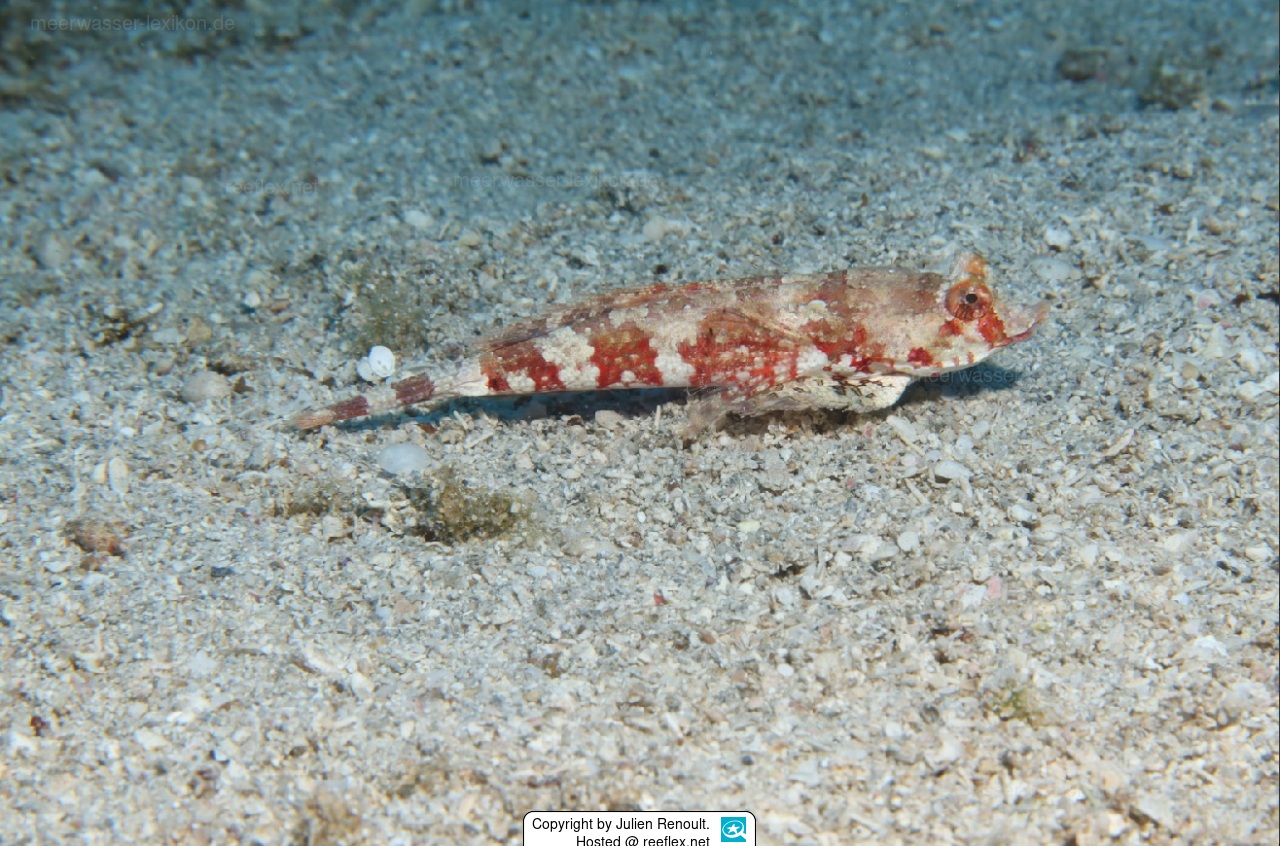
 Julien Renoult, Frankreich


Info
Synchiropus sechellensis was first described by Charles Tate Regan in 1908 based on specimens collected by Stanley Gardiner.
A single specimen of the species was collected around the Amirantes Islands, Seychelles, with a TL of 15.4 cm from a depth of just under 55 meters.
This species also belongs to the Lessepsian migrants; it reached the Mediterranean via the Red Sea and the Suez Canal. Find reports from Israel, Greece, and Turkey are listed under “Further Links.”
The easternmost known range of the species has been documented from the Chesterfield Islands (east coast of Australia) to the Grande Terre Group (New Caledonia).
Brief description:
The color of fresh female and male specimens: reddish-orange with whitish body stripes/patterns
The lyrefish’s body is elongated and slightly flattened.
In females, the first dorsal fin is shorter than in males, and the skin between the spines is orange with a few black spots.
The snout is short and rounded, and the eyes are large.
In males, however, the first spine of the first dorsal fin is long, followed by three small and shorter spines, and between the spines there is a yellow membrane with small black spots at the base of the fin, which enlarge toward the distal part of the fin.
The snout is long and not rounded.
In both females and males, the rays of the second dorsal fin are reddish-orange.
The rays of the pectoral fins are reddish and black at the fin tips.
The rays of the anal fin are red, with the distal parts deep black.
The caudal fin features vertical, dark bands with two arches.
Synonyme:
Synchiropus altivelis Regan, 1908 · unaccepted
Synchiropus normani Schultz & Woods, 1948 · unaccepted (junior synonym)
We would like to extend our sincere thanks to Julien Renoult for the first two photos of live animals from the Mediterranean (Turkey).
A single specimen of the species was collected around the Amirantes Islands, Seychelles, with a TL of 15.4 cm from a depth of just under 55 meters.
This species also belongs to the Lessepsian migrants; it reached the Mediterranean via the Red Sea and the Suez Canal. Find reports from Israel, Greece, and Turkey are listed under “Further Links.”
The easternmost known range of the species has been documented from the Chesterfield Islands (east coast of Australia) to the Grande Terre Group (New Caledonia).
Brief description:
The color of fresh female and male specimens: reddish-orange with whitish body stripes/patterns
The lyrefish’s body is elongated and slightly flattened.
In females, the first dorsal fin is shorter than in males, and the skin between the spines is orange with a few black spots.
The snout is short and rounded, and the eyes are large.
In males, however, the first spine of the first dorsal fin is long, followed by three small and shorter spines, and between the spines there is a yellow membrane with small black spots at the base of the fin, which enlarge toward the distal part of the fin.
The snout is long and not rounded.
In both females and males, the rays of the second dorsal fin are reddish-orange.
The rays of the pectoral fins are reddish and black at the fin tips.
The rays of the anal fin are red, with the distal parts deep black.
The caudal fin features vertical, dark bands with two arches.
Synonyme:
Synchiropus altivelis Regan, 1908 · unaccepted
Synchiropus normani Schultz & Woods, 1948 · unaccepted (junior synonym)
We would like to extend our sincere thanks to Julien Renoult for the first two photos of live animals from the Mediterranean (Turkey).


