


 Raffles Bulletin of Zoology (RBZ)


Info
On November 20, 2022, and on December 11 and 12, 2024, Dr. Kunto Wibowo collected previously unknown gobies of the genus Gobiodon using a hand net around the islands of Seram and Ambon, both of which are located in the Maluku Archipelago and belong to the Indonesian province of Maluku.
The first description of the new Gobiodon species Gobiodon limmoni was then published on April 6, 2026.
The new coral goby lives as a commensal in the large-polyped stony coral Acropora gemmifera, where it is generally very well protected from predators.
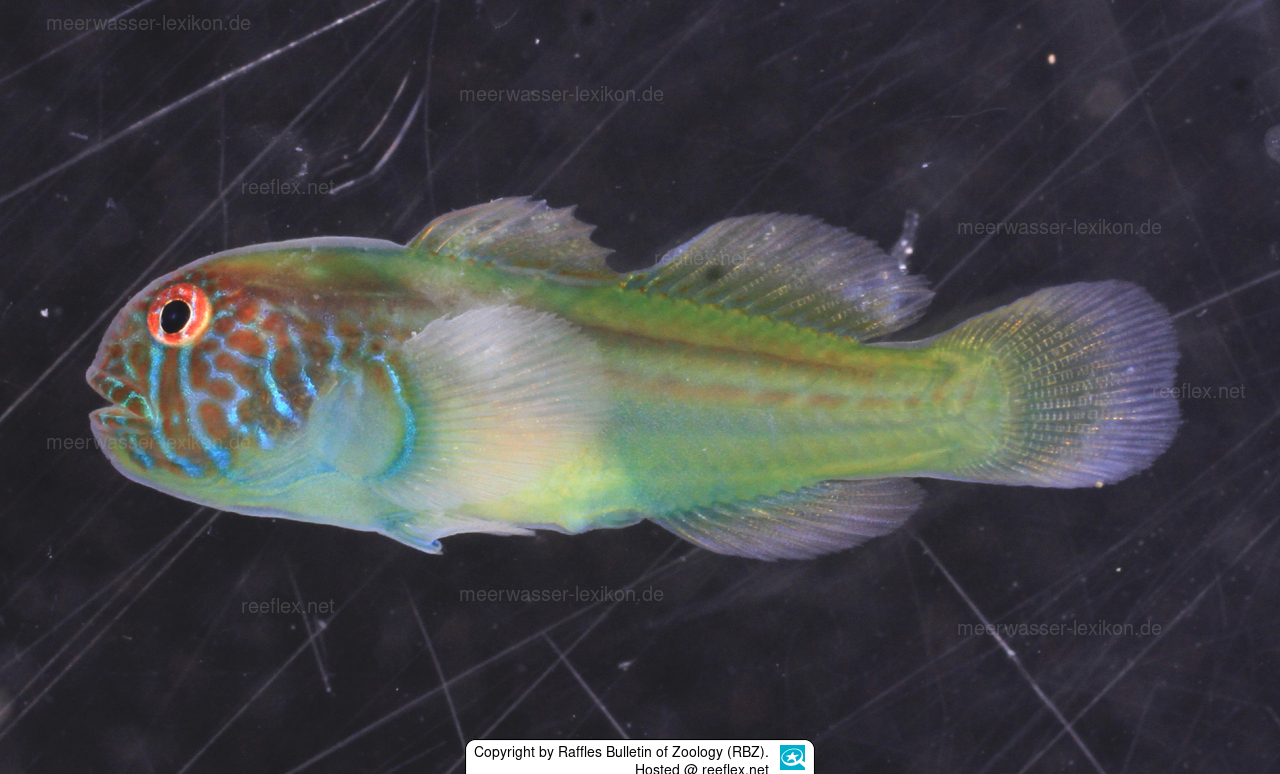
The body is greenish-brown to greenish-gray, with an indistinct brownish longitudinal stripe on the upper lateral surface, extending from the posterior edge of the eye socket to just below the posterior end of the dorsal fin base.
The ground color of Gobiodon limmoni is greenish-brown to greenish-gray on the head and body, with interconnected, vertically slanted, irregular red-orange spots and worm-like stripes in the cheek and gill cover areas.
The spaces between them are pale blue-green to blue-gray and form a net-like pattern.
Unlike other Gobiodon species, there is no distinct dark spot at the posterodorsal tip of the gill opening.
The eye is surrounded by a narrow red-orange ring.
All fins of Limmon’s coral goby are equipped with semi-transparent membranes; the dorsal fins have a small reddish-orange spot at the base of each membrane between the rays.
The head and body of this coral-associated goby are scaleless; the gill opening is large and extends ventrally to the level of the lowest pectoral fin base.
However, research data on the species’ diet and reproduction are still lacking.
Etymology:
The species name “limmoni” was chosen in honor of Gino V. Limmon (Pattimura University), who generously supported the study of the fish fauna in the waters around the Moluccas (Indonesia).
We would like to express our sincere thanks to Dr. Kunto Wibowo for providing the two photos of the new species,
The first description of the new Gobiodon species Gobiodon limmoni was then published on April 6, 2026.
The new coral goby lives as a commensal in the large-polyped stony coral Acropora gemmifera, where it is generally very well protected from predators.
The body is greenish-brown to greenish-gray, with an indistinct brownish longitudinal stripe on the upper lateral surface, extending from the posterior edge of the eye socket to just below the posterior end of the dorsal fin base.
The ground color of Gobiodon limmoni is greenish-brown to greenish-gray on the head and body, with interconnected, vertically slanted, irregular red-orange spots and worm-like stripes in the cheek and gill cover areas.
The spaces between them are pale blue-green to blue-gray and form a net-like pattern.
Unlike other Gobiodon species, there is no distinct dark spot at the posterodorsal tip of the gill opening.
The eye is surrounded by a narrow red-orange ring.
All fins of Limmon’s coral goby are equipped with semi-transparent membranes; the dorsal fins have a small reddish-orange spot at the base of each membrane between the rays.
The head and body of this coral-associated goby are scaleless; the gill opening is large and extends ventrally to the level of the lowest pectoral fin base.
However, research data on the species’ diet and reproduction are still lacking.
Etymology:
The species name “limmoni” was chosen in honor of Gino V. Limmon (Pattimura University), who generously supported the study of the fish fauna in the waters around the Moluccas (Indonesia).
We would like to express our sincere thanks to Dr. Kunto Wibowo for providing the two photos of the new species,


