Anzeige
Fauna Marin GmbH Tunze BAS Whitecorals.com Fauna Marin GmbH

Turbo fluctuosus Mexican Turbo Snail

Turbo fluctuosus is commonly referred to as Mexican Turbo Snail. Difficulty in the aquarium: Easy. A aquarium size of at least 50 Liter is recommended. Toxicity: Toxic hazard unknown.


Profilbild Urheber De Jong Marinelife, Holland

copyright DeJong Marinelife


Courtesy of the author De Jong Marinelife, Holland . Please visit www.dejongmarinelife.nl for more information.

Uploaded by AndiV.

Image detail


Profile

lexID:
4581 
AphiaID:
413380 
Scientific:
Turbo fluctuosus 
German:
Turbo Schnecke 
English:
Mexican Turbo Snail 
Category:
 
Family tree:
Animalia (Kingdom) > Mollusca (Phylum) > Gastropoda (Class) > Trochida (Order) > Turbinidae (Family) > Turbo (Genus) > fluctuosus (Species) 
Initial determination:
W. Wood, 1828 
Occurrence:
Gulf of California, Gulf of Mexico, Mexico (East Pacific) 
Marine Zone:
Subtidal, sublittoral, infralittoral, deep zone of the oceans from the lower limit of the intertidal zone (intertidal) to the shelf edge at about 200 m water depth. neritic. 
Sea depth:
0,3 - 9 Meter 
Size:
up to 1.97" (5 cm) 
Temperature:
73.4 °F - 80.6 °F (23°C - 27°C) 
Food:
Algae (Algivore), algae grazer, epiphytes feeder, Bryopsis, Herbivorous 
Tank:
11 gal (~ 50L)  
Difficulty:
Easy 
Offspring:
Possible to breed 
Toxicity:
Toxic hazard unknown 
CITES:
Not evaluated 
Red List:
Not evaluated (NE) 
Related species at
Catalog of Life
:
 
More related species
in this lexicon
:
 
Author:
Publisher:
Meerwasser-Lexikon.de
Created:
Last edit:
2023-11-30 16:23:29 

Captive breeding / propagation

The offspring of Turbo fluctuosus are possible. Unfortunately, the number of offspring is not large enough to cover the demand of the trade. If you are interested in Turbo fluctuosus, please ask your dealer for offspring. If you already own Turbo fluctuosus, try breeding yourself. This will help to improve the availability of offspring in the trade and to conserve natural stocks.

Info

Turbo fluctuosus W. Wood, 1828

Also known as the Turban or Top Shell Snail, Turbo fluctuosa has a thick, top- or turban-shaped shell with an irridescent interior. The Turbo Snail is native to the Gulf of California off the coast of Mexico.

Synonyms:
Callopoma fluctatum (Reeve, 1848)
Callopoma fluctatum var. depressum P. P. Carpenter, 1856
Turbo (Callopoma) fluctuosus W. Wood, 1828
Turbo assimilis Kiener, 1847
Turbo fluctuatus Reeve, 1848
Turbo fokkesi Jonas, 1843
Turbo tessellatus Kiener, 1848
The term "reef safe" is often used in marine aquaristics, especially when buying a new species people often ask if the new animal is "reef safe".
What exactly does reef safe mean?

To answer this question, you can ask target-oriented questions and inquire in forums, clubs, dealers and with aquarist friends:

- Are there already experiences and keeping reports that assure that the new animal can live in other suitably equipped aquariums without ever having caused problems?

- Is there any experience of invertebrates (crustaceans, hermits, mussels, snails) or corals being attacked by other inhabitants such as fish of the same or a different species?

- Is any information known or expected about a possible change in dietary habits, e.g., from a plant-based diet to a meat-based diet?

- Do the desired animals leave the reef structure "alone", do they constantly change it (boring starfish, digger gobies, parrotfish, triggerfish) and thus disturb or displace other co-inhabitants?

- do new animals tend to get diseases repeatedly and very quickly and can they be treated?

- Do known peaceful animals change their character in the course of their life and become aggressive?

- Can the death of a new animal possibly even lead to the death of the rest of the stock through poisoning (possible with some species of sea cucumbers)?

- Last but not least the keeper of the animals has to be included in the "reef safety", there are actively poisonous, passively poisonous animals, animals that have dangerous biting or stinging weapons, animals with extremely strong nettle poisons, these have to be (er)known and a plan of action should have been made in advance in case of an attack on the aquarist (e.g. telephone numbers of the poison control center, the treating doctor, the tropical institute etc.).
If all questions are evaluated positively in the sense of the animal(s) and the keeper, then one can assume a "reef safety".

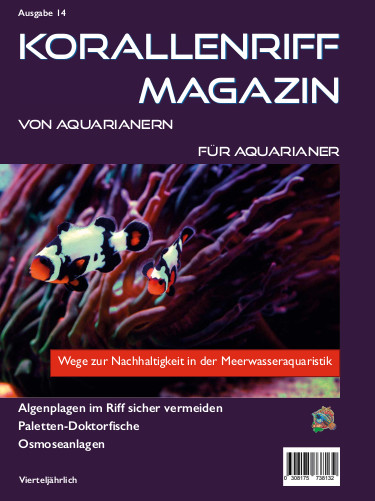
Korallenriff Magazin

Cover Korallenriff Magazin Ausgabe 14

Ausgabe #14
Algenplagen im Riff sicher vermeiden

Ein besonders hilfreicher Artikel von Michael Megerle, der sich mehr mit dem Vermeiden von Algenplagen beschäftigt als mit der Bekämpfung durch käufliche Mittel - aus unserem Archiv Korallenriff.de

Weiterlesen

External links

  1. https://tropical-fish-keeping.com/ (en). Abgerufen am 23.01.2023.
  2. World Register of Marine Species (WoRMS) (en). Abgerufen am 07.08.2020.

Pictures

Commonly

copyright DeJong Marinelife
1

Husbandry know-how of owners

0 husbandary tips from our users available
Show all and discuss