



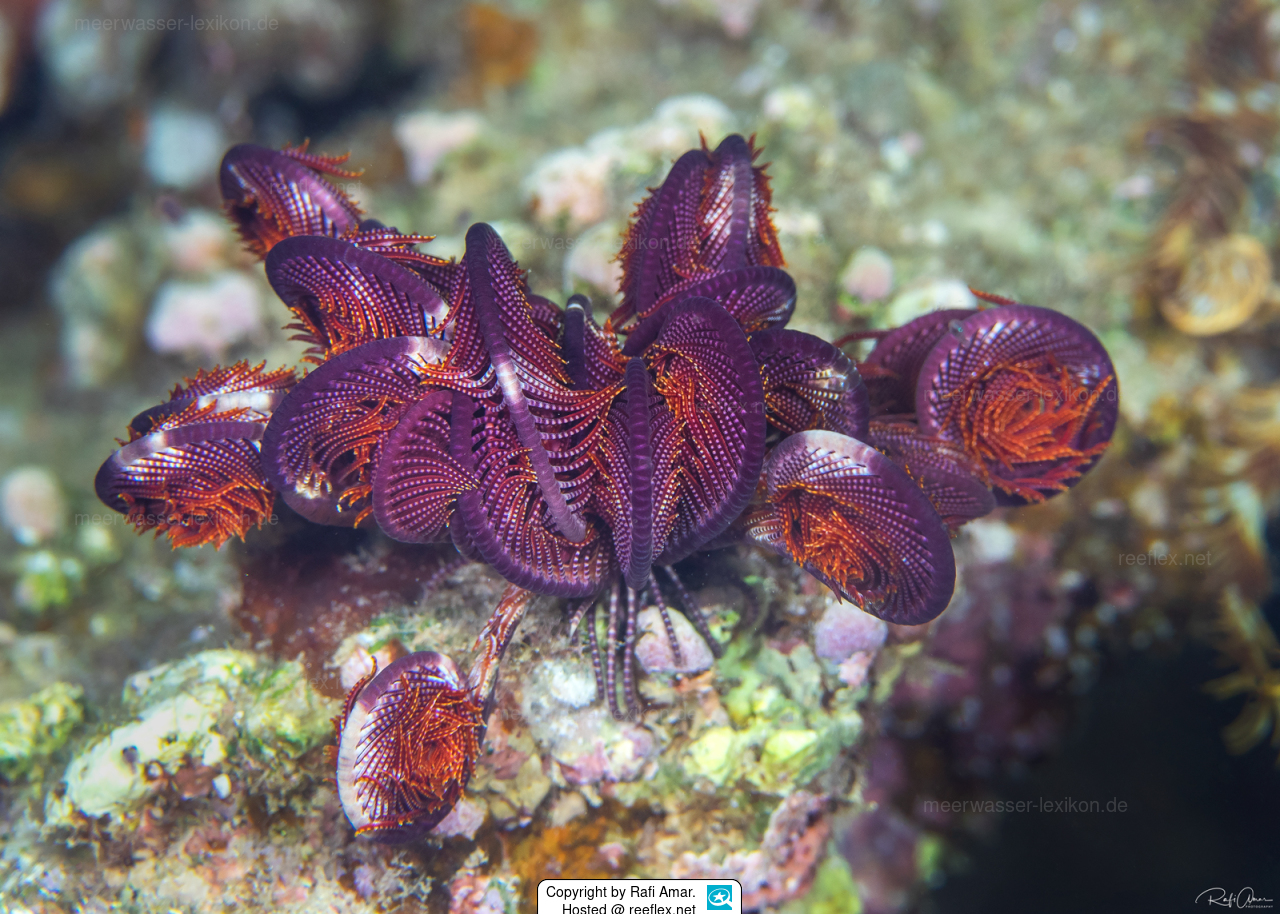
 Rafi Amar, Israel


Info
Dichrometra palmata (Müller, 1841)
Like other echinoderms, feather stars are symmetrical, have a spiny skin, and possess what are known as tube feet.
Like brittle stars, feather stars also have long, thin, and highly flexible arms.
However, “crinoids,” as feather stars are also called, are much more spectacular than ordinary starfish or brittle stars; with their long, feathery arms, which they can extend “explosively,” they are a true “feast for the eyes” in the reef.
The arms grow from a cup-shaped structure in the center of the feather star, called the calyx.
Unlike those of sea stars and brittle stars, they are not used for locomotion but exclusively for feeding and protecting the calyx (mouth/anus).
They consist of small bony plates (similar to the human ossicles), made of calcium carbonate, and are connected to one another, much like a bicycle chain.
Along the entire length of the arms are rows of tiny finger-like structures called pinnulae, which give the animal its feathered appearance.
Each pinnula is segmented and has a groove in the center that runs into a groove in the center of the arm.
These furrows or grooves are lined with cilia and coated with a sticky mucus.
The calyx contains the digestive organs and is separated by a soft membrane called the tegmen.
It looks somewhat like a cone that covers the calyx with a “drumhead.”
Unlike starfish and brittle stars, hair stars have their mouth opening facing upward.
However, the mouth may be located in the center of the calyx or more toward the side.
The anus is also on the upper side; in some species, it is located at the tip of a cone or an anal tube.
On the underside are movable feet, known as cirri.
They serve to cling to sponges or corals.
$hair star
Synonymised names:
Alecto palmata Müller, 1841 (basionym)
Antedon aequipinna Carpenter, 1882 (synonym)
Antedon amboinensis Hartlaub, 1890 (synonym)
Antedon brevicuneata Carpenter, 1881 (synonym)
Antedon conjungens Carpenter, 1888 (synonym)
Antedon gyges Bell, 1884 (synonym)
Antedon imparipinna Carpenter, 1882 (synonym)
Antedon klunzingeri Hartlaub, 1890 (synonym)
Antedon laevicirra Carpenter, 1881 (synonym)
Antedon lepida Hartlaub, 1890 (synonym)
Antedon moorei Bell, 1894 (synonym)
Antedon occulta Carpenter, 1888 (synonym)
Antedon okelli Chadwick, 1904 (synonym)
Antedon palmata (Müller, 1841) (synonym)
Antedon similis Carpenter, 1888 (synonym)
Antedon subtilis Hartlaub, 1895 (synonym)
Antedon tenera Hartlaub, 1890 (synonym)
Comatula (Alecto) palmata (Müller, 1841) (synonym)
Dichrometra klunzingeri (Hartlaub, 1890) (synonym)
Dichrometra protectus (Carpenter, 1879) (synonym)
Dichrometra tenera (Hartlaub, 1890) (synonym)
Lamprometra klunzingeri (Hartlaub, 1890) (synonym)
Lamprometra palmata (Müller, 1841) (synonym)
Lamprometra palmata gyges (Bell, 1884) (synonym)
Lamprometra palmata palmata (Müller, 1841) (synonym)
Lamprometra palmata parmata (Müller, 1841) (lapsus calami)
Lamprometra protecta (Carpenter, 1879) (synonym)
Lamprometra protectus (Carpenter, 1879) (synonym)
Like other echinoderms, feather stars are symmetrical, have a spiny skin, and possess what are known as tube feet.
Like brittle stars, feather stars also have long, thin, and highly flexible arms.
However, “crinoids,” as feather stars are also called, are much more spectacular than ordinary starfish or brittle stars; with their long, feathery arms, which they can extend “explosively,” they are a true “feast for the eyes” in the reef.
The arms grow from a cup-shaped structure in the center of the feather star, called the calyx.
Unlike those of sea stars and brittle stars, they are not used for locomotion but exclusively for feeding and protecting the calyx (mouth/anus).
They consist of small bony plates (similar to the human ossicles), made of calcium carbonate, and are connected to one another, much like a bicycle chain.
Along the entire length of the arms are rows of tiny finger-like structures called pinnulae, which give the animal its feathered appearance.
Each pinnula is segmented and has a groove in the center that runs into a groove in the center of the arm.
These furrows or grooves are lined with cilia and coated with a sticky mucus.
The calyx contains the digestive organs and is separated by a soft membrane called the tegmen.
It looks somewhat like a cone that covers the calyx with a “drumhead.”
Unlike starfish and brittle stars, hair stars have their mouth opening facing upward.
However, the mouth may be located in the center of the calyx or more toward the side.
The anus is also on the upper side; in some species, it is located at the tip of a cone or an anal tube.
On the underside are movable feet, known as cirri.
They serve to cling to sponges or corals.
$hair star
Synonymised names:
Alecto palmata Müller, 1841 (basionym)
Antedon aequipinna Carpenter, 1882 (synonym)
Antedon amboinensis Hartlaub, 1890 (synonym)
Antedon brevicuneata Carpenter, 1881 (synonym)
Antedon conjungens Carpenter, 1888 (synonym)
Antedon gyges Bell, 1884 (synonym)
Antedon imparipinna Carpenter, 1882 (synonym)
Antedon klunzingeri Hartlaub, 1890 (synonym)
Antedon laevicirra Carpenter, 1881 (synonym)
Antedon lepida Hartlaub, 1890 (synonym)
Antedon moorei Bell, 1894 (synonym)
Antedon occulta Carpenter, 1888 (synonym)
Antedon okelli Chadwick, 1904 (synonym)
Antedon palmata (Müller, 1841) (synonym)
Antedon similis Carpenter, 1888 (synonym)
Antedon subtilis Hartlaub, 1895 (synonym)
Antedon tenera Hartlaub, 1890 (synonym)
Comatula (Alecto) palmata (Müller, 1841) (synonym)
Dichrometra klunzingeri (Hartlaub, 1890) (synonym)
Dichrometra protectus (Carpenter, 1879) (synonym)
Dichrometra tenera (Hartlaub, 1890) (synonym)
Lamprometra klunzingeri (Hartlaub, 1890) (synonym)
Lamprometra palmata (Müller, 1841) (synonym)
Lamprometra palmata gyges (Bell, 1884) (synonym)
Lamprometra palmata palmata (Müller, 1841) (synonym)
Lamprometra palmata parmata (Müller, 1841) (lapsus calami)
Lamprometra protecta (Carpenter, 1879) (synonym)
Lamprometra protectus (Carpenter, 1879) (synonym)


