

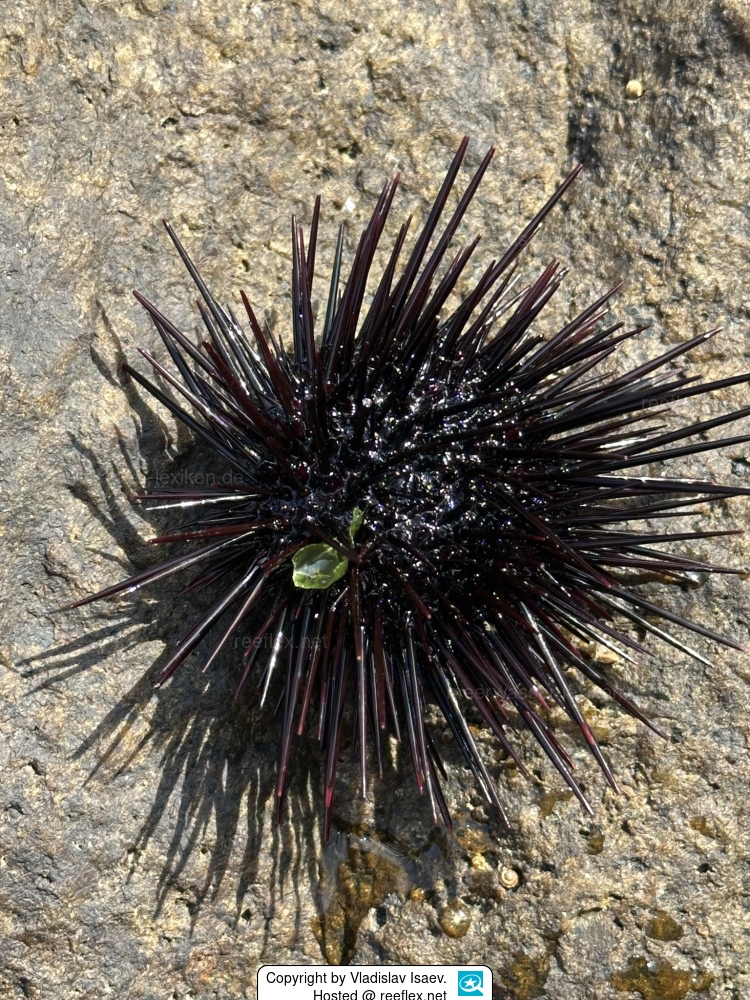
 Vladislav Isaev, China / Russland


Info
Heliocidaris crassispina lives in shallow, rocky reef areas where algae such as arame and kajime grow abundantly in Japanese waters, and uses its hard teeth to feed on these algae.
SeaLifeBase states that this species is also carnivorous and does not shy away from carrion.
Sea urchins feed using a structure known as “Aristotle's lantern,” consisting of five hard plates joined together like a beak.
With this specialized and complex jaw apparatus, they feed primarily on algae and seaweed.
The spines covering its entire body not only protect Heliocidaris crassispina from predators but also prevent it from being pulled out of rock crevices and depressions.
Through their burrowing behavior, sea urchins contribute significantly to the (re)structuring of marine benthic communities.
Heliocidaris crassispina is also sold as food, with the sea urchin’s gonads—often mistakenly referred to as roe—considered a delicacy in Japan and many other regions of the world.
In Japan, they are among the most popular sushi ingredients.
Synonyms:
Anthocidaris crassispina (A. Agassiz, 1864) · unaccepted (transferred to Heliocidaris)
Anthocidaris purpurea (von Martens, 1886) · unaccepted (subjective junior synonym)
Authoeidaris Erassispina · unaccepted (misspelling)
Strongylocentrotus globulosus (A. Agassiz, 1864) · unaccepted (subjective junior synonym)
Strongylocentrotus purpureus (von Martens, 1886) · unaccepted (subjective junior synonym)
Toxocidaris crassispina A. Agassiz, 1864 · unaccepted (transferred to Heliocidaris)
Toxocidaris globulosa A. Agassiz, 1864 · unaccepted (subjective junior synonym)
Toxocidaris purpurea von Martens, 1886 · unaccepted (subjective junior synonym)
.
SeaLifeBase states that this species is also carnivorous and does not shy away from carrion.
Sea urchins feed using a structure known as “Aristotle's lantern,” consisting of five hard plates joined together like a beak.
With this specialized and complex jaw apparatus, they feed primarily on algae and seaweed.
The spines covering its entire body not only protect Heliocidaris crassispina from predators but also prevent it from being pulled out of rock crevices and depressions.
Through their burrowing behavior, sea urchins contribute significantly to the (re)structuring of marine benthic communities.
Heliocidaris crassispina is also sold as food, with the sea urchin’s gonads—often mistakenly referred to as roe—considered a delicacy in Japan and many other regions of the world.
In Japan, they are among the most popular sushi ingredients.
Synonyms:
Anthocidaris crassispina (A. Agassiz, 1864) · unaccepted (transferred to Heliocidaris)
Anthocidaris purpurea (von Martens, 1886) · unaccepted (subjective junior synonym)
Authoeidaris Erassispina · unaccepted (misspelling)
Strongylocentrotus globulosus (A. Agassiz, 1864) · unaccepted (subjective junior synonym)
Strongylocentrotus purpureus (von Martens, 1886) · unaccepted (subjective junior synonym)
Toxocidaris crassispina A. Agassiz, 1864 · unaccepted (transferred to Heliocidaris)
Toxocidaris globulosa A. Agassiz, 1864 · unaccepted (subjective junior synonym)
Toxocidaris purpurea von Martens, 1886 · unaccepted (subjective junior synonym)
.

