


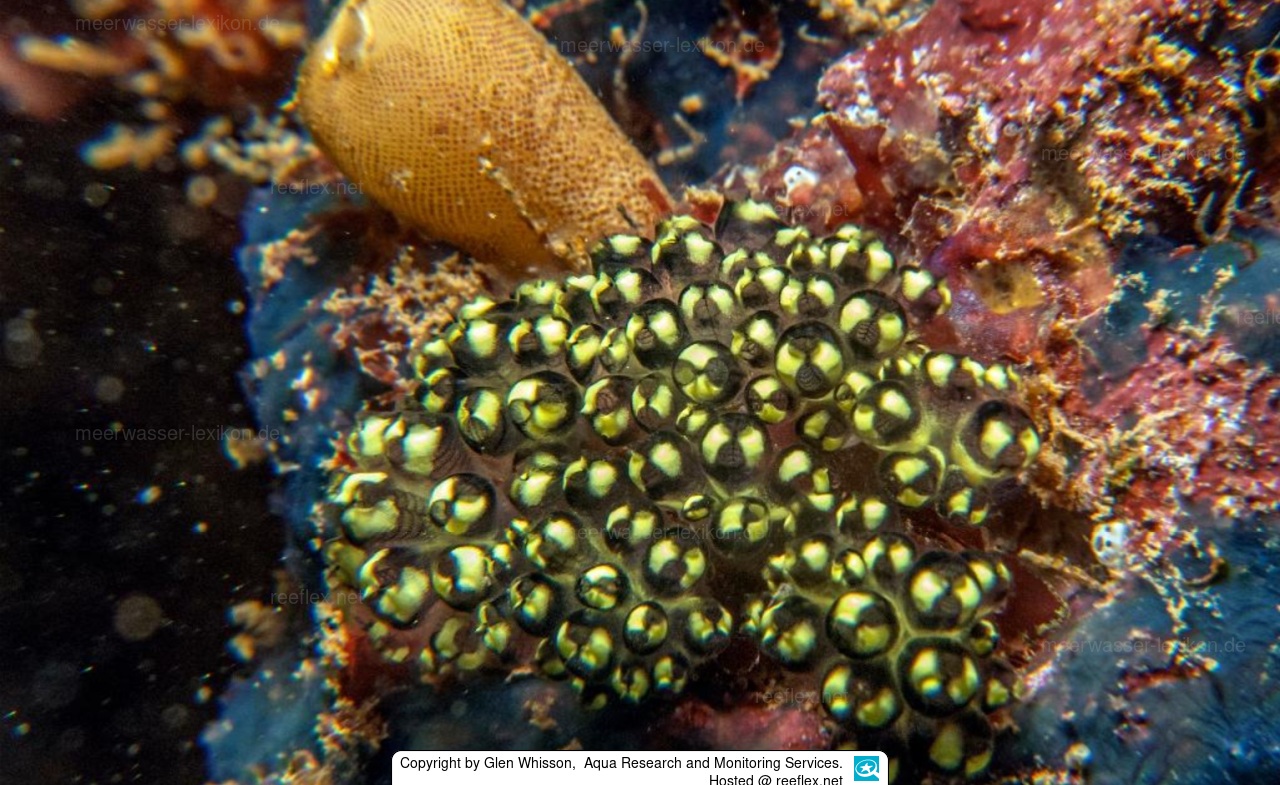
 Dr. Glen Whisson, Aqua Research and Monitoring Services, Australien


Info
Clavelina arafurensis was first discovered in the Arafura Sea between northern Australia and the island of New Guinea and was first described in 1952.
It is a colonial sea squirt that varies greatly in appearance from region to region. Here is a short excerpt from the first description:
"The color of the specimens from the Philippines in this collection (Fig. 115B) differs from the usual appearance of the species, as depicted by Kott (1990: Plate 1e, f) and Monniot F. & Monniot C. (1996: Plate 6b), and also differs from the specimens from Mozambique.
In the Philippines, the tunic is transparent, and the edge of the siphons, the prepharyngeal band, the endostyle, and the transverse vessels show black pigmentation.
In one of the colonies, the zoids have two white spots that are denser at the edge than in the center and are arranged anterolaterally, as in other geographical regions.
In other specimens, no spots were visible at all.
When alive, the tunic of the sea squirt is transparent and the thoracic parts are translucent, black or purple, with two opaque yellow-green spots on either side of the mouth siphon.
This pattern and color appear to be characteristic of the species.
Interestingly, the species has even been found in Tanzania and Mozambique, East Africa, in the western Indian Ocean.
It is a colonial sea squirt that varies greatly in appearance from region to region. Here is a short excerpt from the first description:
"The color of the specimens from the Philippines in this collection (Fig. 115B) differs from the usual appearance of the species, as depicted by Kott (1990: Plate 1e, f) and Monniot F. & Monniot C. (1996: Plate 6b), and also differs from the specimens from Mozambique.
In the Philippines, the tunic is transparent, and the edge of the siphons, the prepharyngeal band, the endostyle, and the transverse vessels show black pigmentation.
In one of the colonies, the zoids have two white spots that are denser at the edge than in the center and are arranged anterolaterally, as in other geographical regions.
In other specimens, no spots were visible at all.
When alive, the tunic of the sea squirt is transparent and the thoracic parts are translucent, black or purple, with two opaque yellow-green spots on either side of the mouth siphon.
This pattern and color appear to be characteristic of the species.
Interestingly, the species has even been found in Tanzania and Mozambique, East Africa, in the western Indian Ocean.


