





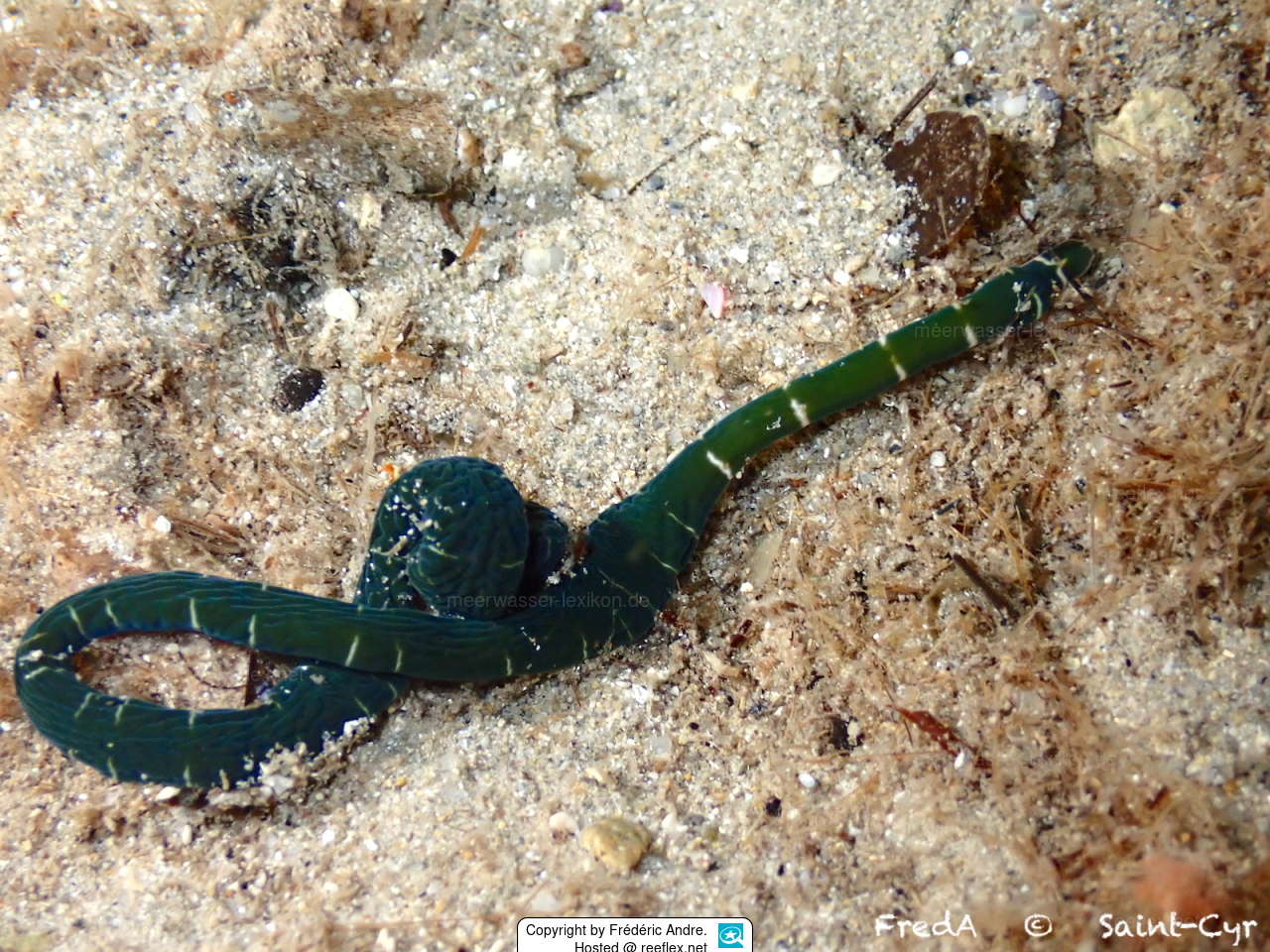
 Frédéric Andre, Frankreich


Info
Intro:
What is the largest living organism in the world?
The fungus Armillaria ostoyae, whose network spans an area of nine square kilometers—that’s about 1,200 soccer fields
What is the largest living animal in the world?
Many would surely guess the blue whale, with a maximum length of 35 meters.... Far from it—the threadworm Lineus longissimus (Gunnerus, 1770) beats it, reaching lengths of up to 60 meters! Hard to believe, but true.
According to WoRMS, Notospermus geniculatus grows “only” up to 5 meters long
A distinctive feature of ribbon worms is a special, extendable proboscis that may contain stilettos and venom glands and serves not only for hunting but also for exploring the surroundings.
Notospermus geniculatus is carnivorous and sexually dimorphic; however, hermaphroditism also occurs in ribbon worms.
Inofrmation:
The combination of toxins used by Notospermus geniculatus is not dangerous to humans, but it is dangerous to living prey.
Since the banded threadworm—also known as the banded shoelace—also consumes carrion, it helps keep its environment clean.
Synonyms:
Borlasia annulata (Ehrenberg, 1831) · unaccepted (synonym (partim))
Cerebratulus anas Joubin & François, 1892 · unaccepted (synonym)
Cerebratulus fasciatus Stimpson, 1857 · unaccepted (junior synonym)
Cerebratulus geniculatus (Delle Chiaje, 1822) · unaccepted > junior subjective synonym
Cerebratulus knerii (Diesing, 1850) · unaccepted > junior subjective synonym
Lineus anas · unaccepted (synonym)
Lineus australis Punnett, 1900 · unaccepted > junior subjective synonym
Lineus digueti Joubin, 1905 · unaccepted (synonym)
Lineus geniculatus (Delle Chiaje, 1822) · unaccepted (synonym)
Meckelia fasciata (Stimpson, 1857) · unaccepted > superseded combination
Meckelia fasciatus · unaccepted (synonym)
Meckelia knerii Diesing, 1850 · unaccepted (basionym)
Micrura tridacnae Gibson, 1981 · unaccepted (synonym)
Nemertes drepanensis Huschke, 1830 · unaccepted (synonym)
Nemertes geniculata (Delle Chiaje, 1822) · unaccepted > superseded combination
Nemertes geniculata f. pontica Czerniavsky, 1881 · unaccepted > superseded rank
Notospermus drepanensis Huschke, 1830 · unaccepted > junior subjective synonym
Polia geniculata Delle Chiaje, 1822 · unaccepted (synonym)
What is the largest living organism in the world?
The fungus Armillaria ostoyae, whose network spans an area of nine square kilometers—that’s about 1,200 soccer fields
What is the largest living animal in the world?
Many would surely guess the blue whale, with a maximum length of 35 meters.... Far from it—the threadworm Lineus longissimus (Gunnerus, 1770) beats it, reaching lengths of up to 60 meters! Hard to believe, but true.
According to WoRMS, Notospermus geniculatus grows “only” up to 5 meters long
A distinctive feature of ribbon worms is a special, extendable proboscis that may contain stilettos and venom glands and serves not only for hunting but also for exploring the surroundings.
Notospermus geniculatus is carnivorous and sexually dimorphic; however, hermaphroditism also occurs in ribbon worms.
Inofrmation:
The combination of toxins used by Notospermus geniculatus is not dangerous to humans, but it is dangerous to living prey.
Since the banded threadworm—also known as the banded shoelace—also consumes carrion, it helps keep its environment clean.
Synonyms:
Borlasia annulata (Ehrenberg, 1831) · unaccepted (synonym (partim))
Cerebratulus anas Joubin & François, 1892 · unaccepted (synonym)
Cerebratulus fasciatus Stimpson, 1857 · unaccepted (junior synonym)
Cerebratulus geniculatus (Delle Chiaje, 1822) · unaccepted > junior subjective synonym
Cerebratulus knerii (Diesing, 1850) · unaccepted > junior subjective synonym
Lineus anas · unaccepted (synonym)
Lineus australis Punnett, 1900 · unaccepted > junior subjective synonym
Lineus digueti Joubin, 1905 · unaccepted (synonym)
Lineus geniculatus (Delle Chiaje, 1822) · unaccepted (synonym)
Meckelia fasciata (Stimpson, 1857) · unaccepted > superseded combination
Meckelia fasciatus · unaccepted (synonym)
Meckelia knerii Diesing, 1850 · unaccepted (basionym)
Micrura tridacnae Gibson, 1981 · unaccepted (synonym)
Nemertes drepanensis Huschke, 1830 · unaccepted (synonym)
Nemertes geniculata (Delle Chiaje, 1822) · unaccepted > superseded combination
Nemertes geniculata f. pontica Czerniavsky, 1881 · unaccepted > superseded rank
Notospermus drepanensis Huschke, 1830 · unaccepted > junior subjective synonym
Polia geniculata Delle Chiaje, 1822 · unaccepted (synonym)


