


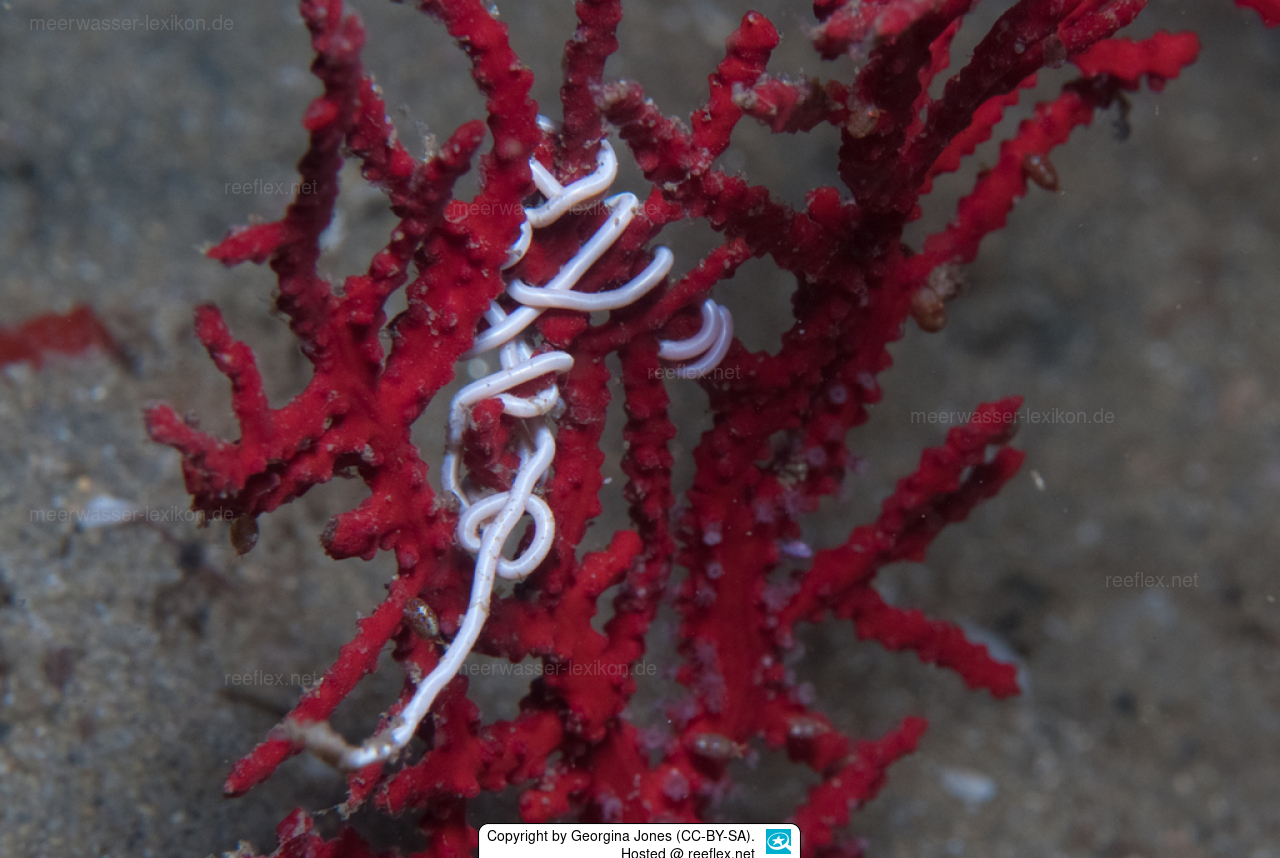
 Georgina Jones (CC-BY-SA), Cape Town

Info
Fecampiida sp.01
Since Fecampiida sp.01 was first described, no further morphological studies have been conducted on the species. Observations of adult Fecampiida sp.01 in the shrimp Palaemon serratus, a new host for the parasite on the French Atlantic coast, led to elucidation of the morphology of the species and its development in the cocoon.
Morphologically these worms are characteristic. They lack an intestine, have a hermaphrodite reproductive system (morphologically different from other platyhelminths) and a very extensive glandular organ that secretes the cocoon. They are pinkish-salmon colored with a striking crimson head. Only one worm can be found in a cocoon, suggesting that they are self-fertile (Caullery & Mesnil, 1903).
Since Fecampiida sp.01 was first described, no further morphological studies have been conducted on the species. Observations of adult Fecampiida sp.01 in the shrimp Palaemon serratus, a new host for the parasite on the French Atlantic coast, led to elucidation of the morphology of the species and its development in the cocoon.
Morphologically these worms are characteristic. They lack an intestine, have a hermaphrodite reproductive system (morphologically different from other platyhelminths) and a very extensive glandular organ that secretes the cocoon. They are pinkish-salmon colored with a striking crimson head. Only one worm can be found in a cocoon, suggesting that they are self-fertile (Caullery & Mesnil, 1903).


