



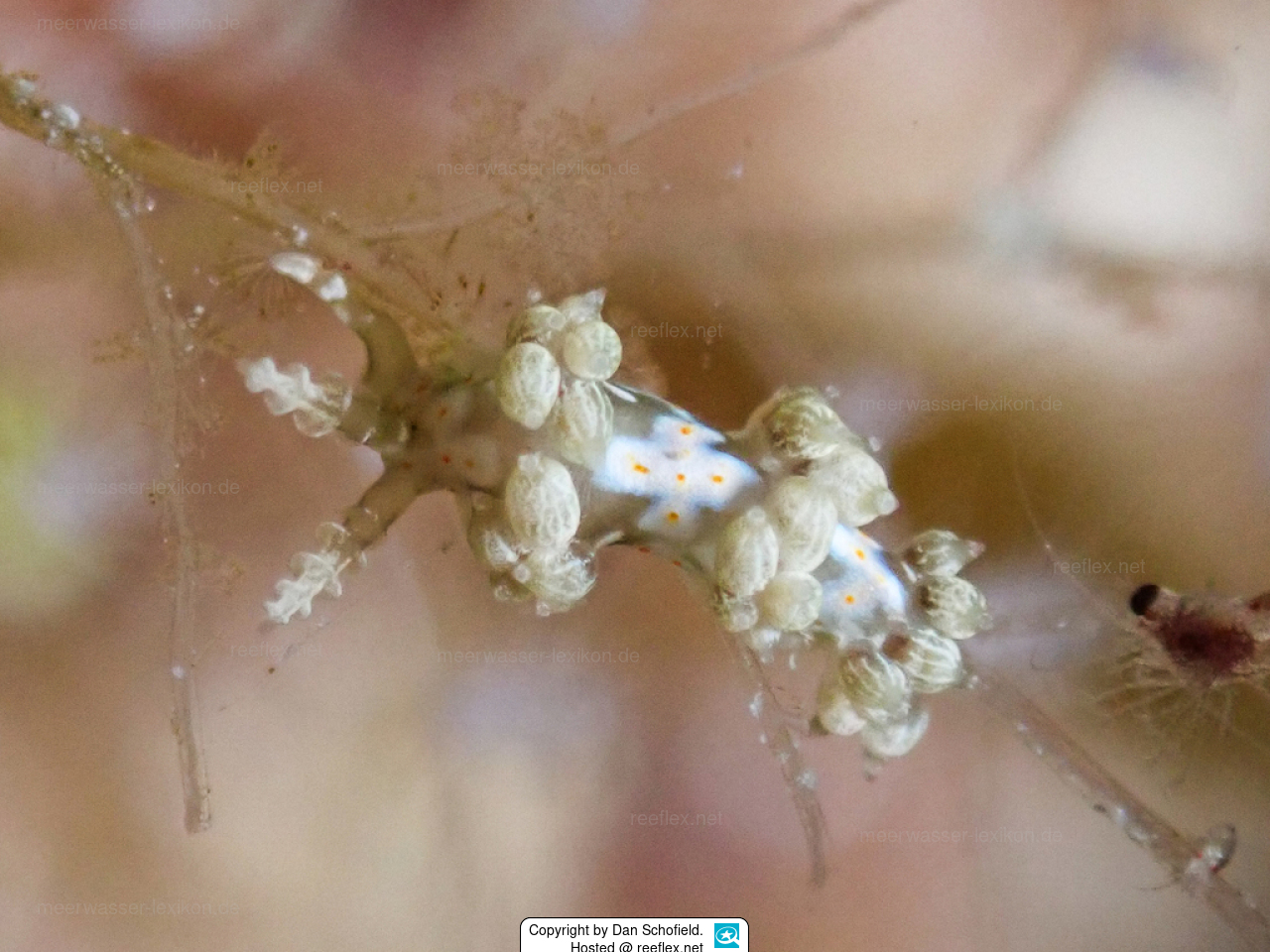
 Dan Schofield, UK


Info
Nanuca leali Henryco, Meirelles, García-Méndez, Camacho-García, Á. Valdés, Schrödl & Padula, 2025
The type locality for the description of Nanuca leali is Florida, USA. The specific epithet leali honours José Henrique Nóbrega Leal, Scientific Director and Curator of the Bailey-Matthews National Shell Museum in Florida and editor of the journal The Nautilus.
Description of Nanuca leali: Body beige with white patches on the dorsum and irregular orange spots over the white areas. Sides of the body with short, irregular orange lines from the head to the anterior end. Foot margin translucent with opaque white spots. Posterior end of the foot white with a single row of orange spots. Oral tentacles long (one fifth of body length), beige with several irregular white spots. Rhinophores large, annulate, with four large rings, distal rings smaller; beige with few white spots. Cerata beige to orange with longitudinal white stripes.
Whereas Nanuca sebastiani Er. Marcus, 1957 remained the only species of its genus for many decades after its description in 1957, five new species were described in 2025.


