


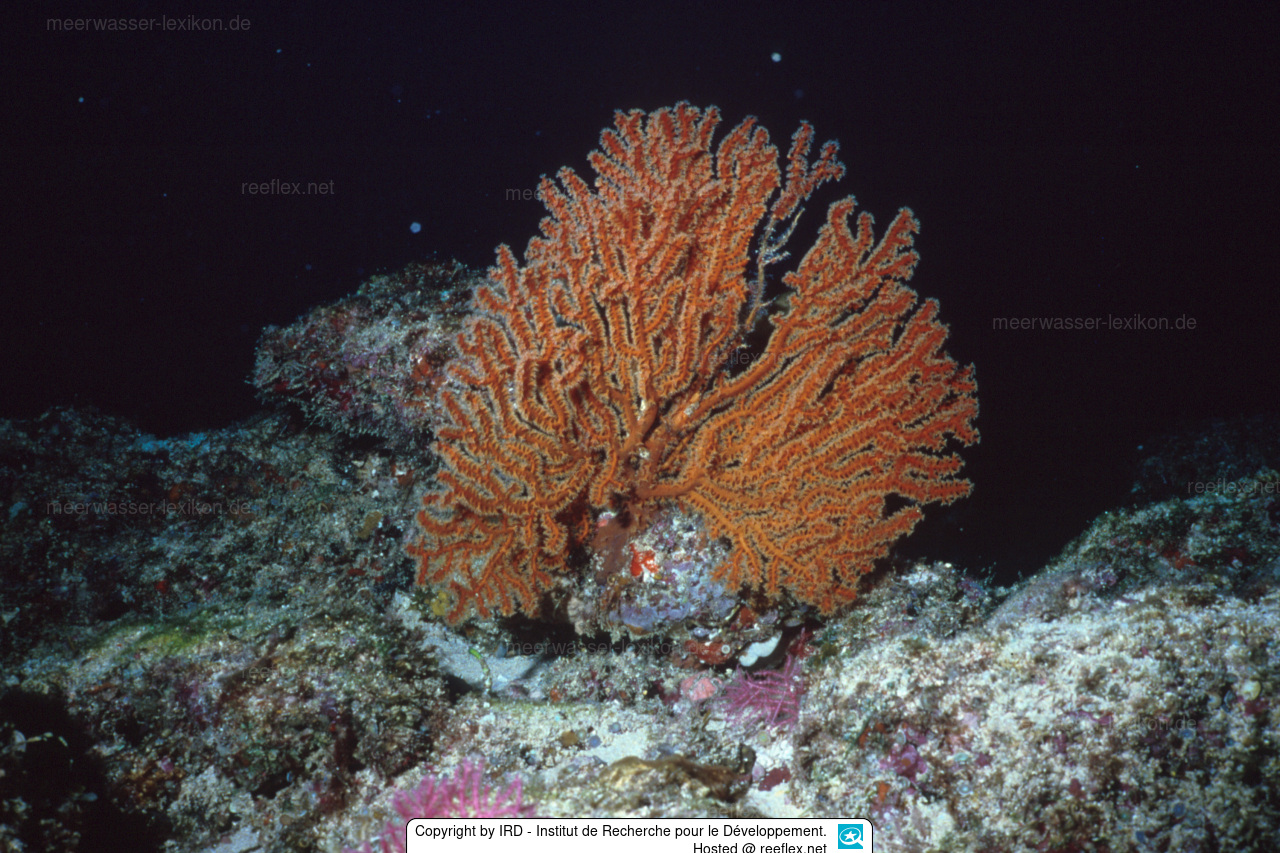
 IRD - Institut de Recherche pour le Développement, Neuseeland


Info
Anthogorgia ochracea was described in 1999 by Dr. Grasshoff in New Caledonia and was long considered an endemic species.
In the following years, sightings were reported from the South China Sea and from the Andaman and Nicobar Islands in the Indian Ocean.
Grasshoff states that the sea fan grows up to 50 cm high, but lists in the initial description under Material on page 30 that a fragment with a length of 1 meter, holotype HNHM, is available.
The polyps of the gorgonian are arranged irregularly, with one side of the main branches remaining free.
Polyps are 1.4–1.7 mm wide and 1.5–2.0 mm high.
The sclerites that provide stability are covered with large tubercles, many of which are elongated transversely (a feature not observed in Anthogorgia species from other regions).
The coenenchyme is covered with large spindles and small sclerites with smooth elevations and very small capstans.
Color: Sclerites amber, fan rust red; color in life dark red to reddish brown.
Habitat:
Around New Caledonia on the outer reef slope and on the outer wall of channels.
Etymology:
The species name “ochracea” is derived from the Latin “ochraceus” for the color ocher and refers to the color of the coral.
In the following years, sightings were reported from the South China Sea and from the Andaman and Nicobar Islands in the Indian Ocean.
Grasshoff states that the sea fan grows up to 50 cm high, but lists in the initial description under Material on page 30 that a fragment with a length of 1 meter, holotype HNHM, is available.
The polyps of the gorgonian are arranged irregularly, with one side of the main branches remaining free.
Polyps are 1.4–1.7 mm wide and 1.5–2.0 mm high.
The sclerites that provide stability are covered with large tubercles, many of which are elongated transversely (a feature not observed in Anthogorgia species from other regions).
The coenenchyme is covered with large spindles and small sclerites with smooth elevations and very small capstans.
Color: Sclerites amber, fan rust red; color in life dark red to reddish brown.
Habitat:
Around New Caledonia on the outer reef slope and on the outer wall of channels.
Etymology:
The species name “ochracea” is derived from the Latin “ochraceus” for the color ocher and refers to the color of the coral.

